About
This website is maintained by and for the approximately 1000 members of AFSCME Retirees, Council 31, Subchapter 161, based in the northern suburbs of Chicago. Diane Stokes is President of the Subchapter. This site is maintained by the Communications Committee, John Metz, Chairman. Email communications may be addressed to: afscmeretirees161@gmail.com. Phone messages may be left at our voicemail number: (224) 366-7339.
(Revision version 0320)
-
Useful Links for AFSCME Retirees
- AFSCME home page Updated regularly, much useful information
- AFSCME Works AFSCME WORKS is the official publication of the American Federation of State, County and Municipal Employees.
- Alliance for Retired Americans See weekly “Friday Alerts”, more
- Fred Klonsky's blog Daily posts from a retired public school teacher who is just looking at the data.
- Glen Brown Defending public pensions against fools, rogues, and oppressors since 2011.
- Illinois AFL-CIO
- Jane Addams Senior Caucus Jane Addams Senior Caucus is a multiracial, grassroots organization led by concerned seniors in the Chicago area.
- Jane Addams Senior Caucus: Caucus Connection Bi-Weekly Online Update from Jane Addams Senior Caucus
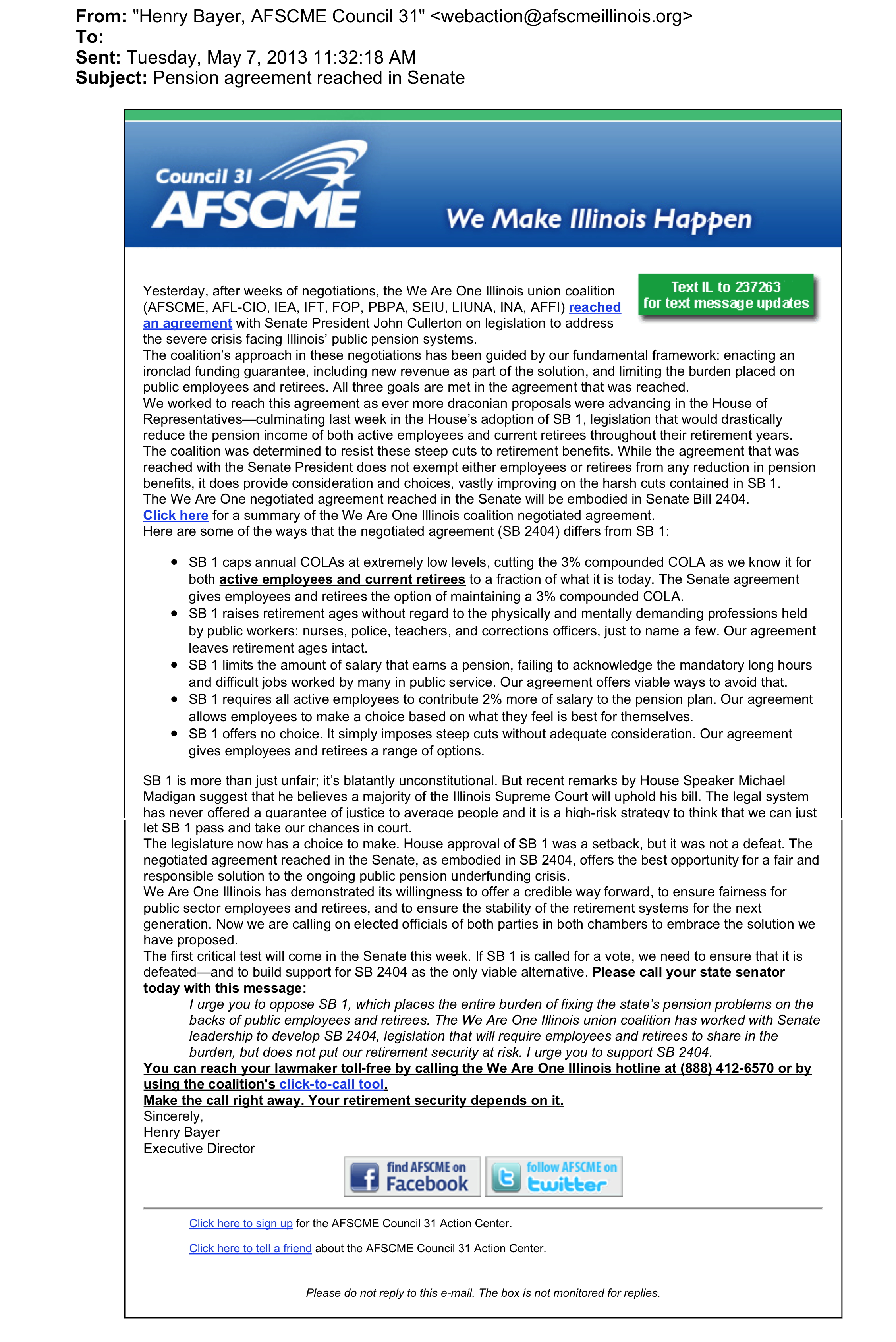
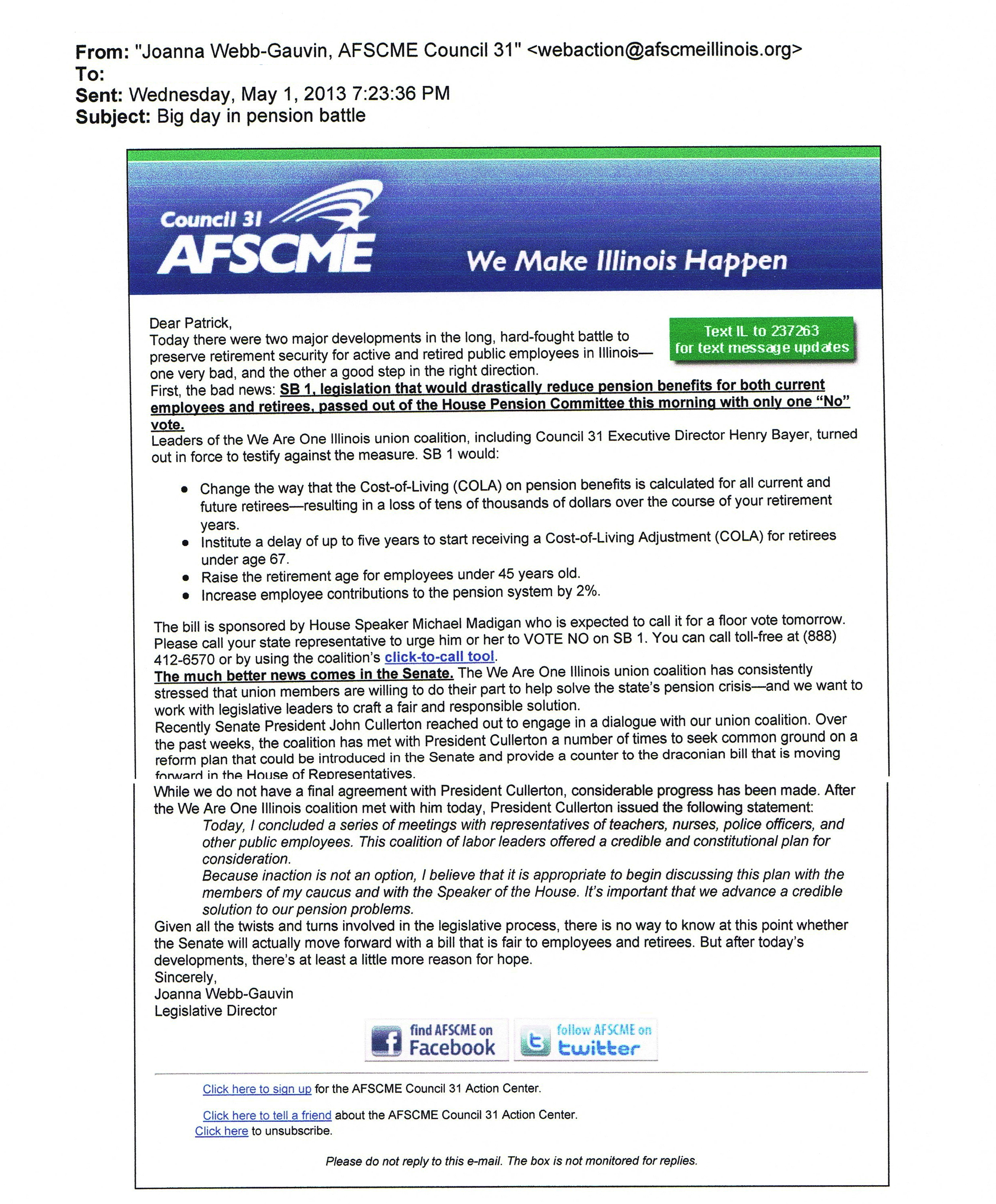
5/7/13: Letters from WE ARE ONE ILLINOIS, AFSCME COUNCIL 31, and AFSCME RETIREES COUNCIL 31
For WE ARE ONE ILLINOIS, click here.
For AFSCME Council 31 Action Center, click here.
Posted in Uncategorized
Leave a comment
Announcements 4/15/13
email from President Charlie Hogan sent to members with email addresses:
Greetings. This email is part of our effort to improve communications among members of our subchapter. You may reply to it in your email program if you have any questions or comments. (We’re still working on our address list, so ignore this if you’ve already seen it.)
The next monthly meeting of the subchapter will be on April 17th at Ruby Tuesday’s, 5203 Old Orchard Rd., Skokie. The guest speaker will be Maria Britten-Sipe, Council 31’s Retiree Coordinator. The State and State University retirees’ healthcare will be discussed. If you expect to attend, RSVP President Charlie Hogan at chogan9494@sbcglobal.net. The restaurant needs a headcount in order to setup the room.
As you are probably aware, the Governor and Legislature have recently been acting in ways that may not be advantageous to our current pensions and benefits. All members and their families should call their state senator and representative to express our opposition to legislative changes in our current pensions and benefits. Specifically, those interested in retirees’ pensions should urge their state senators to vote NO on HB 1165. They should also express support for SB 2404. Call your state senators by Wednesday April 10th when the Senate will be back in session. We Are One Union Coalition hotline 888-412-6570 will connect you to your state senator with prompts.
You are also invited to visit our blogsite at https://afscmeretirees161.wordpress.com/ There you will find information and links that may be helpful to you. This site will undergo frequent updates so you may want to check it regularly.
Mary Bennett of the Executive Board of Sub-chapter 161 has received the following emails that may be of interest to members (click to read the messages, source addresses are listed for each message but links within the messages are not active):
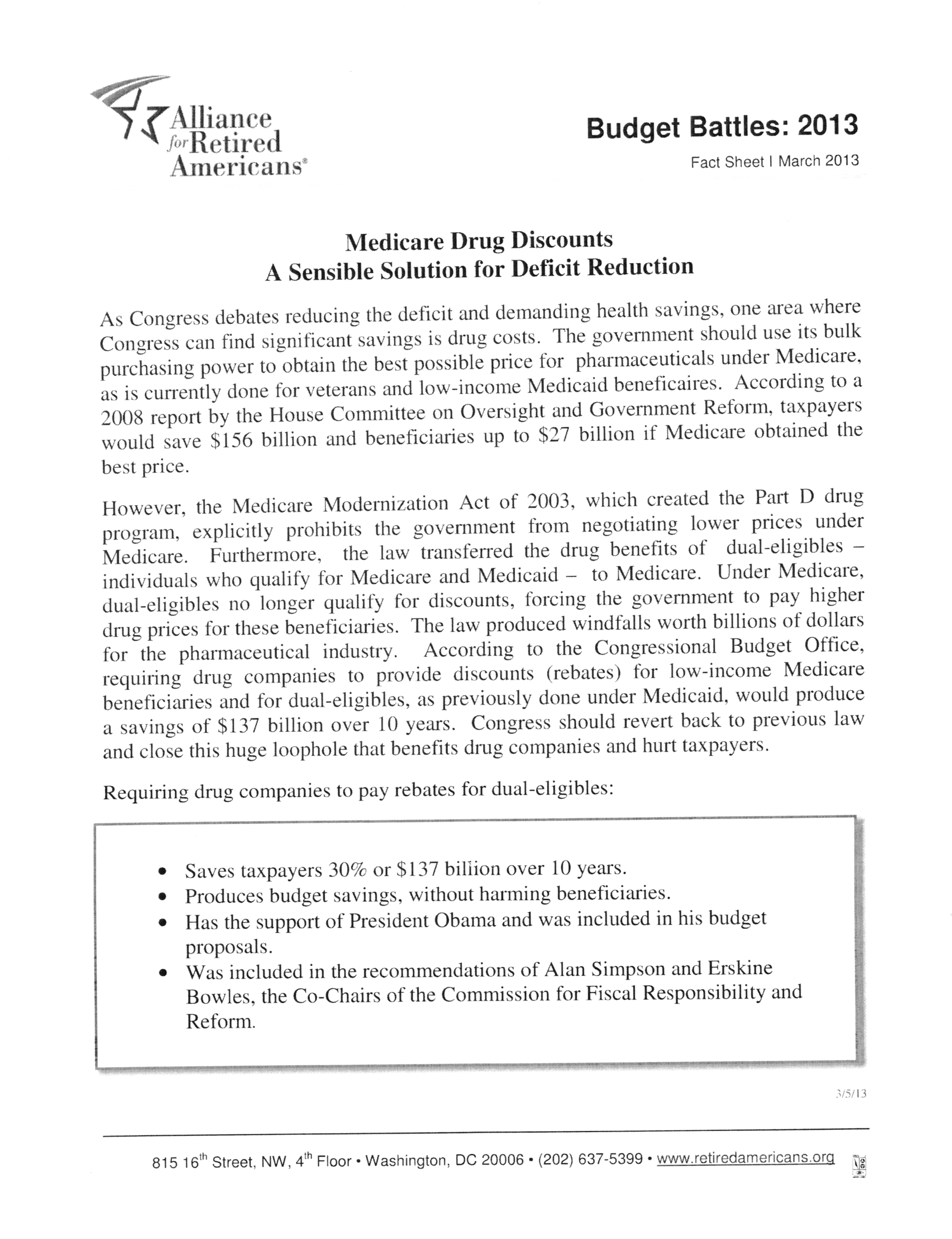
Big Pharma’s Price-Gouging Exposed
Coalition on Human Needs
State Level Tax Cuts Don’t Boost Job Growth
Obama’s Budget
April 12 Friday Alert
In addition, here are highlights of the top news stories from March 22, 2013.
Trumka: Austerity Only Weakens the Economy
Join Drive to Save Saturday Delivery
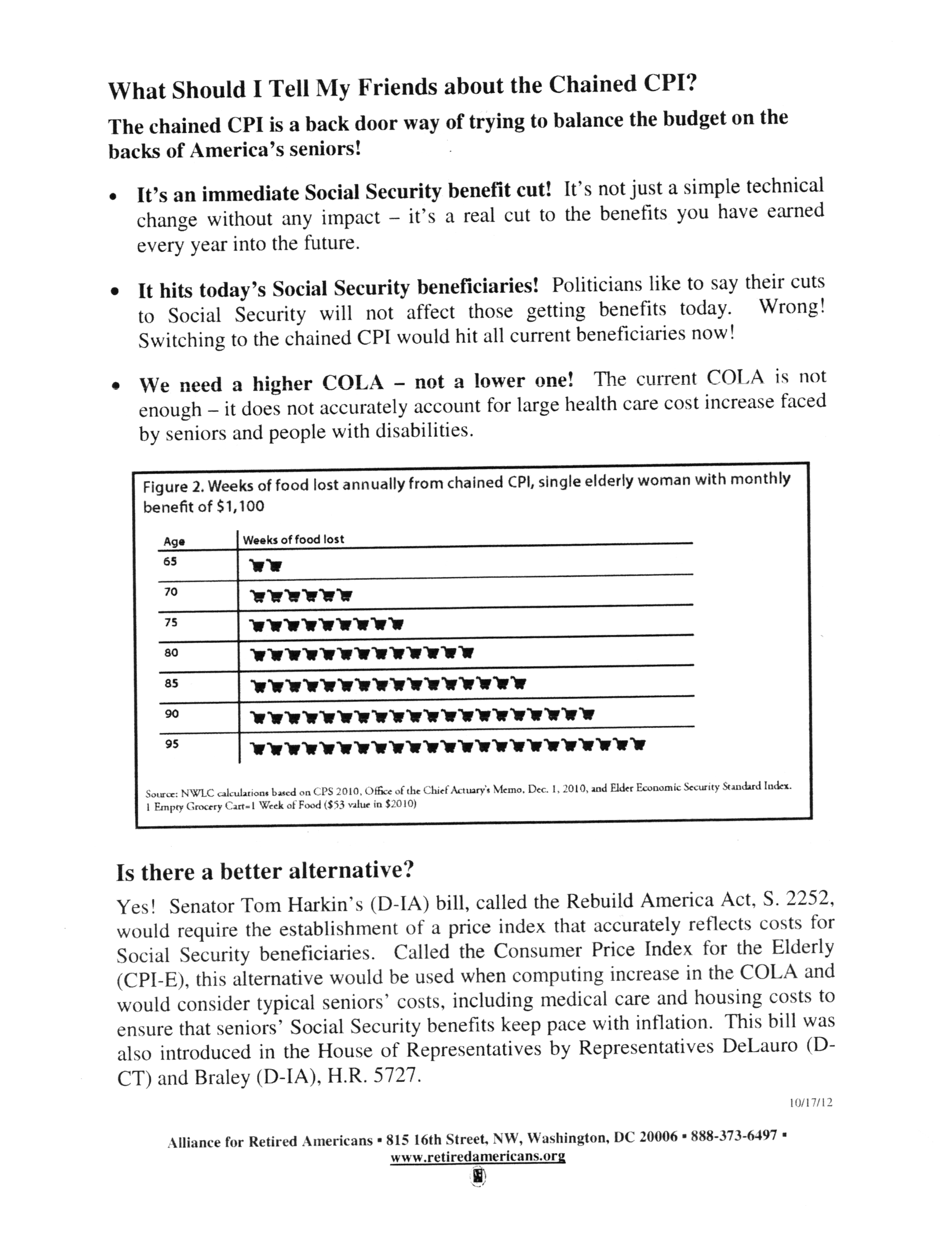
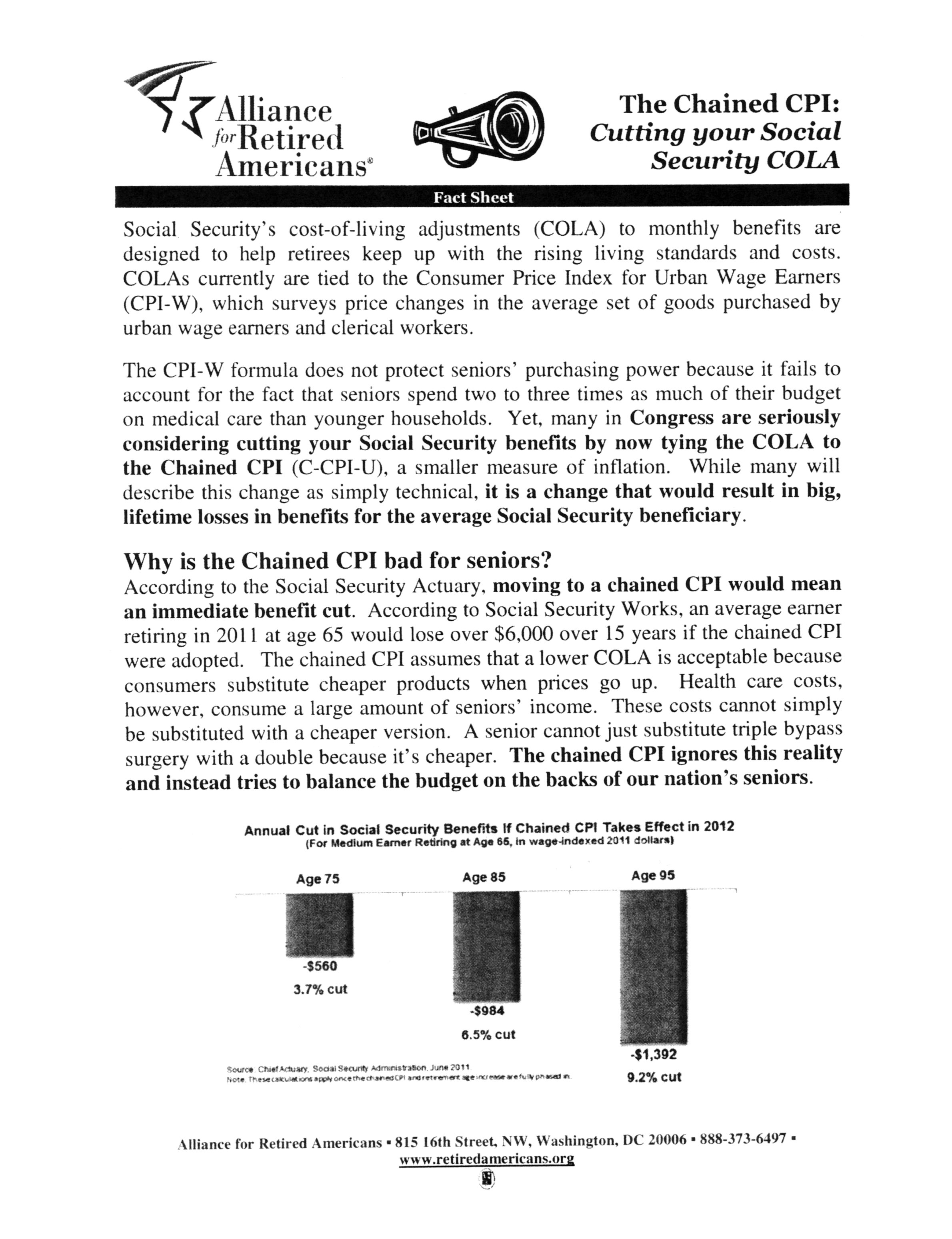
Top Economist Rejects ‘Chained’ CPI
Read more stories on the AFL-CIO Now blog.
Did you know that Congress has already voted to destroy your Post Office – and they can reverse it right now, whenever they want?
In 2006, George W. Bush signed a bill that his party’s congress drafted to effectively kill the Postal Service by requiring it to prefund their workers’ retirement benefits 75 years into the future.
Put another way, the Postal Service would be financially a-okay if Congress weren’t forcing it to fund the full retiree health benefits for workers that aren’t even born yet – something no country, corporation or government service has ever had to do.
ENOUGH: There is no mail budget crisis. There is a Congressional crisis. And it’s time for Congress to stop destroying our postal service. Sign on with us if you agree:
http://other98.com/congress-stop-destroying-our-postal-service/
Posted in Uncategorized
Leave a comment
Health, Dental and Vision Benefits
The battle to preserve quality affordable health care for both active and retired employees was at the core of the fight for a fair contract that AFSCME members waged over the past 15 months. Never before had Management pushed for such excessive and unaffordable increases. The Employer’s proposal would have increased the average employee health care costs by more than $10,000 over the three-year contract. Costs would have increased by as much as $8,000 a year for many retirees.
The Bargaining Committee succeeded in staving off this massive health care cost-shifting. The Tentative Agreement ensures that state employees and retirees continue to have access to quality, affordable health care.
– NO requirement that employees and retirees pay a percentage of total costs
Management demanded that the employee and retiree share of the health premiums be determined as a percentage of the overall cost of the health plan, automatically going up each year, rather than the current practice where the union contract locks in the specific amount to be deducted.
The Bargaining Committee refused to agree to shifting to employee/retiree premiums based on a percentage of the overall premium cost which would have resulted in employee/retiree premiums uncontrollably going up—with much sharper increases in each succeeding year.
- NO retroactive employee and retiree health care cost increases
Management demanded that all increases in employee and retiree premiums, co-pays and deductibles be effective July 1, 2012—which would have meant that employees and retirees would have incurred huge retroactive health care contribution costs.
The Bargaining Committee resisted this demand and prevailed: No health care changes will go into effect until July 1, 2013.
– NO massive increases in premiums. co-pays and deductibles
Management demanded massive increases in employee costs for premiums, co-pays and deductibles. Under Management’s proposals, premiums would have skyrocketed in the first year of the contract, as would most co-pays and deductibles.
The Bargaining Committee fought for more than a year against these excessive increases—and beat them back! Under the Tentative Agreement, the increase in premiums for active employees will be 1% of pay. That 1% of pay will be added to the actual dollar amount currently deducted, and will of course be more than offset by the general pay increase. Dependent premiums will increase but will continue to be a flat dollar amount.
The Committee also succeeded in preventing steep hikes in co-pays and deductibles that would have severely penalized employees or their family members who had the misfortune to suffer serious or chronic illness. The co-pay and deductible rates that the Union achieved take into account the rising costs of health care without placing such an excessive burden on employees or retirees.
Retiree Health
The Bargaining Committee fought to minimize the impact of the newly-enacted Public Act 97-695 (originally SB 1313) by limiting the premium costs that could be imposed on retirees. Under the original CMS implementation plan, many retirees would have paid more than 20% of their pension income for health care premiums. Now retirees will pay only a small fraction of that.
Premiums–Medicare Eligible Retirees
Effective 7-1-13, Medicare Eligible retirees will have 1% of their pension annuity deducted to pay for their share of the health care premium. Effective 7-1-14, an additional 1% will be deducted.
Effective 1-1-14, all Medicare Eligible Retirees will be enrolled in a Medicare Advantage plan that provides a comparable level of services and a comparable range of providers as the current health plans. According to the U.S. Medicare website: A Medicare Advantage Plan is a type of Medicare health plan offered by a private company that contracts with Medicare to provide you with all your Part A and Part B benefits. Medicare Advantage Plans include Health Maintenance Organizations, Preferred Provider Organizations, Private Fee-for-Service Plans, Special Needs Plans, and Medicare Medical Savings Account Plans.
Medicare Eligible dependents enrolled in a MCHP plan will pay no more than $89.91/month and dependents in a QCHP plan will pay no more than $142/month through 6-30-15–the same rates they are currently paying.
Premiums–Pre-65 Non-Medicare Eligible Retirees
Effective 7/1/13, pre-65 Non-Medicare Eligible retirees will be offered a $500/month subsidy if they opt out of the state’s group health insurance plan to be covered in another health insurance plan. Effective 7-1-13, Pre-65 Non-Medicare Eligible retirees will have 2% of their pension annuity deducted to pay for their share of the health care premium. Effective 7-1-14, an additional 2% will be deducted.
QCHP
Effective 7-1-13, premium monthly rates for dependents in the Retiree +1 Dependent plan option will increase $53, from $196 to $249.
Effective 7-1-13, premium monthly rates for dependents in the Retiree +2 or More Dependent plan option will increase $61, from $226 to $287.
MCHP
Effective 7-1-13, premium monthly rates for dependents in the Retiree +1 Dependent plan option will increase $19. The current monthly rate of $94 will increase to $113.
Effective 7-1-13, premium monthly rates for dependents in the Retiree +2 or More Dependent plan option will increase $26.50. The current monthly rate of $132.50 will increase to $159.
Managed Care Healt Plans (MCHP)
MCHP Medical
*Effective 7-1-13, Doctor Office Visits will increase from the current $15 to $18, and effective
7-1-14, the visit will increase to $20.
*Effective 7-1-13, Office Visits to specialists and Home Health Visits will increase from the current
$20 to $25, and effective 7-1-14, the visit will increase to $30.
*Effective 7-1-13, the Emergency Room co-pay will increase from the current $200 to $225, and
effective 7-1-14, the co-pay will increase to $250.
*Effective 7-1-13, the Hospital Inpatient co-pay will increase from $275 to $325, and effective
7-1-14, the co-pay will increase to $350.
*Effective 7-1-13, the Hospital Outpatient co-pay will increase from the current $175 to $225,
and effective 7-1-14, the co-pay will increase to $250.
MCHP Prescription Drugs
*Effective 7-1-13, the prescription deductible will increase from $50 to $75, and effective 7-1-14 the deductible will increase to $100.
*Effective 7/1/13:
- Generic drug co-pays will decrease from $10 to $8.
- Formulary co-pays will increase from $24 to $26.
- Non-formulary co-pays will increase from $48 to $50.
*Effective 7/1/13, the Mail Multiplier for prescription drugs will increase from 2x to 2.5x, resulting in a reduction in the cost savings to employees but still costing less than a purchase at the pharmacy.
Oualitv Care Health Plan (OCHP)
QCHP Medical
*The plan year employee deductible will increase, based on salary, to $350-$500 in FY 14 and to
$375-$525 in FY 15.
*Plan year retiree deductible and dependent deductible each increase from $300 to $350 in FY 14
and to $375 in FY 15.
*In-network, in-patient hospitalization deductible for member and dependent will each increase
from $50 to $100 effective 7/1/14
*Out-of-network, in-patient hospitalization deductible for member and dependent will each
increase from $300 to $500, effective 7/1/14
*Emergency room deductibles increase from $400 to $425 in FY 14 and to $450 in FY 15.
*Co-Insurance In-Network will decrease to 85% effective 7/1/14
*Co-Insurance Out-of-Network will decrease to 60% effective 7/1/13.
*Individual Out-of-Pocket Maximum (In-Network) will increase from $1,200 to $1,500
Effective 7/1/13.
*Family Out-of-Pocket Maximum (In-Network) remains at 2.5x the individual rate.
*Individual Out-of-Pocket Maximum (Out-of-Network) will increase from $4,400 to $6,000
Effective 7/1/13.
*Family Out-of-Pocket Maximum (Out-of-Network) remains 2x the individual Out-of-Network rate.
*Lab/X-Ray In-Network co-insurance will decrease to 85% effective 7-1-14.
*Lab/X-Ray Out-of-Network co-insurance will decrease to 60% effective 7/1/13.
QCHP Prescription Drugs
Effective 7-1-13, the prescription deductible will increase from $75 to $100, and effective 7-1-14 the deductible will increase to $125.
Effective 7/1/13 prescription co-pays will change as follows:
- Generic drugs co-pays will decrease from $11 to $10;
- Formulary co-pays will increase from $26 to $30;
- Non-formulary co-pays will increase from $52 to $60.
The Mail Multiplier for a 90-day supply of prescription drugs will increase from 2x the 30-day rate to 2.5x the 30-day rate, resulting in a reduction in the cost savings but still costing less than the pharmacy rate.
Vision
Effective 7/1/14, new lenses will be covered on an annual basis.
Effective 7-1-13, the co-pay for Vision Eye Exams, Vision Lenses, and Vision Standard Frames will increase from $10 to $20. Effective 7-1-14, the co-pays will increase from $20 to $25.
Dental (OCDP)
Effective 7-1-13, the QDCP Annual Deductible will increase from $125 to $150. Effective 7-1-14, the deductible will increase to $175.
Effective 7/1/13, the QDCP Annual Maximum for Out-of-Network will decrease from $2,500 to $2,000.
Effective 7/1/13, the QDCP Orthodontia Maximum for Out-of-Network will decrease from the current $2,000 to $1,500.
Life Insurance
Life Insurance coverage remains unchanged for employees and retirees.
Posted in Uncategorized
Leave a comment
From meeting 03/20/13
Summary materials distributed:
What Expanded and Improved Medicare for All Would Mean for Organized
Labor
Health insurance is off the bargaining table because everybody, including spouses and children, has it
Better benefits: all necessary medical care covered under one plan
Lower cost: no premiums, deductibles, co-pays, insurance, or non-covered services; most people would pay less
Progressive financing: those who have more pay more, those who have less pay less
Money used to purchase health care instead of going to administrative overhead including insurance company profits and executive compensation
Complete choice of providers
No insurance company interference between patients and doctors Portable throughout the United States
No interruptions in coverage for periods of lay-off or other unemployment, no matter how lengthy, including job loss
Need for health insurance not a barrier to changing jobs or careers
Need for health insurance not a barrier to early retirement, or to opening one’s own business or becoming a full-time volunteer; so jobs freed up for younger people
No tax penalties for having good health insurance
No treatment delays while workers comp and regular insurance fight to avoid responsibility
Cost of health insurance not an incentive to employers to reduce hours or shift to temp workers to avoid paying for health insurance
No change in benefits or providers at retirement
Employers save all the costs associated with administrating health insurance
Gets rid of the competitive disadvantage for employers who offer health insurance compared to those who don’t
No one with a contagious disease unable to get care No one goes bankrupt over medical bills
Patients and families don’t waste time fighting with insurance companies; anxiety over medical bills doesn’t interfere with recovery
Improved general population health
Enhanced social solidarity: we are all in the same system instead of being pitted against each other; we all have an incentive to fight for a high quality system
Problems with Obamacare for organized labor
Incentives to employers to stop offering health insurance, reduce hours, and switch to temp workers
Some workers, especially low wage workers especially may suffer “chum,” that is, shift between eligibility for Medicaid and eligibility for subsidies on the exchanges
Tax on plans that offer better coverage, falsely called “Cadillac plans”
No cost controls, so total health care costs will continue to rise, and those costs will be paid by workers
Threats to multi-employer plans (Taft-Hartley plans) include adverse selection, that is. Loss of younger workers as employers drop insurance
So-called “wellness programs” penalize lower wage workers and minorities, who have greater risks of poor health, and sick people in general
Those who have relatively good insurance pitted against those who have poor insurance or none
The Medicaid expansion will be used by the health insurance industry to further Medicaid privatization—forcing recipients into for-profit HMOs; this will set the stage for further privatization of more and more public services
Gives more money and power to the health insurance industry, which will use them to further tilt the playing field toward its own interests and against the interests of the people
Unaffordable under-insurance becomes the standard that pulls everybody down
What we need: Medicare for all, for life.
Everybody in, nobody out. One nation one health plan.
Compiled by Anne Scheetz MD, annescheetz@gmail.com for ISPC, March 2013. Printed in-house with donated labor.
Health care is a human right!
How Expanded and Improved Medicare for All Will Work
What are other names for Expanded and Improved Medicare for All? Single-payer health care, national health insurance, national health program.
Who will be covered under this kind of health insurance? Every person who lives in the United States, from birth to death.
How will I get a doctor?
Because everybody will have the same insurance, you can choose any doctor, dentist, pharmacy, hospital, and other health care professional and institution that you want.
Will I have an insurance card? How will I get it?
Once the program is started, the first time you go for any kind of medical care, you will receive a simple enrollment form to fill out. Once you get your national health insurance card, you will use it whenever you need health care. Until your card comes, you will still receive all the care you need.
What kind of care will be covered?
Preventive care, nurse practitioners, doctors, midwives, hospital, dental, vision, hearing, mental health, prescription medications, chemotherapy, surgery, rehabilitation, wheelchairs and other medical equipment, and all other necessary care.
How much money will I have to pay to see a doctor or dentist? How about prescriptions? How about if I have to go to the emergency room or the hospital?
You will not have to pay anything when you go for any kind of medically necessary care.
What will my insurance premiums be? There will be no health insurance premiums.
Then how does it get paid for?
Everybody who can afford it will pay a tax based on income: the more money you make, the more you pay; the less money you make, the less you pay.
When can I start?
Unfortunately, single-payer health care, or Medicare for All, for life, does not exist yet. We will have to fight for it. To join us in this fight, go to our web site (at top), or to pnhp.org. Or, for more information or to have someone speak to your house party, church, club, or other group, contact Anne Scheetz, 773-486-6276 or armescheetz@gmail.com.
Printed in-house with donated labor.

Posted in Uncategorized
Leave a comment
A Letter from President Charlie Hogan
Dear member,
February 20th meeting at Ruby’s will start at 11AM.Focus: Reports and discussion of our work in response to Springfield’s attacks on our pension/benefits. Before the meeting, do the following:
1) Contact you State Senator and Rep by phone (888-912-5959) or e-mail (go to www.il.gov/legislative branch). Tell them to support We Are One’s call for a Summit to solve the state’s budget issue. .
2) Come to the Biss/Gabel/Fine Forum at the Wilmette Community Rec Center,3000 Glenview Rd, Wilmette. It starts at 7PM, this Monday evening, 2/4/13. Eight of us attended Stean’s Forum last month. Forum’s are 2 way switchboards. Your attendance speaks to the issue’s importance. Your absence does the opposite. Since none of these three legislators have backed the summit, we need to back and push them.
3) If you cannot attend the Forum, help us with visits and contacts with district office staff and the legislator. We still want constituents of Moylan, Martwick, D’Amico and Lang to come with a spokesperson and help us get commitments for the summit. Call me now!
4) John Metz of our e-communications team wants to send you our web page. He needs your e-mail address. We have won 2 fights. We are learning winning tactics as we go. Learn with us. It’s why we organize. You do what you can; together, we do what you cannot.
Charlie
Posted in Uncategorized
Leave a comment